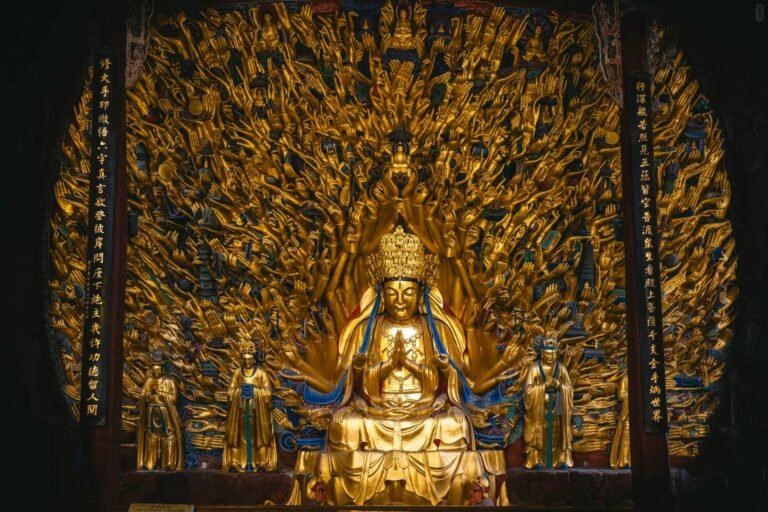

Why a quiet UNESCO day among golden hands, family stories and a stubborn ox may stay with you longer than Chongqing’s neon skyline.
Visiting the Dazu Rock Carvings from Chongqing is worth a full day if you enjoy history, art or stories about ordinary life. Plan about 10 to 11 hours door to door, including roughly 1.5 to 2.25 hours of driving each way and at least 2.5 hours at Baodingshan.
For a first visit, prioritize Baodingshan. Beishan is a quieter, art-focused extension for travelers with extra time. What makes Dazu unusual is not only its age: Buddhist teaching appears through mothers and children, herdsmen and oxen, fear, compassion and the effort to become a better person.
Planning a private day trip from Chongqing? EzGoChina can arrange pickup from a central Chongqing hotel, a private vehicle and a real English- or Spanish-speaking cultural guide confirmed for your date. The route protects Baodingshan instead of rushing through a list of sites. Plan My Dazu Day
In This Guide
- Why Dazu is worth a full day from Chongqing
- What makes Baodingshan different
- Baodingshan or Beishan: which site to choose
- Whether a private guide is worth it
- A realistic Chongqing-to-Dazu itinerary
- Walking, accessibility, weather and ticket planning
- Frequently asked questions
The First Thing You Notice Is Not History
A fan of golden hands opens across the cliff.
A few steps later, a mother leans toward her child. Farther along, a herdsman tries to bring an unsettled ox under control. The animal resists. The rope pulls tight. By the end of the sequence, both man and ox have become calm.
This is what surprises many first-time visitors at the Dazu Rock Carvings. You arrive expecting ancient Buddhist statues. You find people worrying about their parents, losing their temper, working, drinking, raising children and trying to live a better life.
The stone is old. The emotions are not.
That is why Dazu deserves more than a quick stop and a list of carving numbers. Its power lies in the moment when a cliff full of religious images becomes recognizable as human life.
Why Skipping Dazu Can Feel Like a Missed Opportunity
Dazu is easy to leave out of a Chongqing itinerary. The city already offers more viewpoints, food streets and neon nights than most travelers can fit into two or three days. On a screen, a day trip to see “old stone carvings” can sound less urgent than another evening above the river.
The trade-off becomes clearer when you ask what the rest of your trip already contains. China has no shortage of towers, shopping districts and spectacular night views. Dazu gives you something harder to replace: a quiet day with Song-dynasty people whose worries still make sense.
A mother protects a child. A herdsman struggles with an unruly mind, shown as an ox. A wall of golden hands imagines compassion reaching suffering in a thousand different ways. These are not background decorations around a famous Buddha. They are the reason the day matters.
Dazu is not a quick half-day stop. The drive, Baodingshan route and time needed to look properly make it a full-day decision. For most first-time visitors with only one or two days in Chongqing, the city itself should come first. If art and history are your priority, Dazu can still justify one of those days. With three or four days, it becomes one of the strongest ways to add a quieter, more reflective experience to the trip.

What Are the Dazu Rock Carvings?
The Dazu Rock Carvings are a large group of cliff carvings spread through the hills of Dazu, west of central Chongqing. UNESCO inscribed them on the World Heritage List in 1999 for their artistic quality, their religious and secular subject matter, and the way Buddhism, Taoism and Confucianism meet within the wider heritage landscape.
The main flowering took place from the late Tang period through the Song dynasty, especially between the 9th and 13th centuries. This was late in the long history of Chinese cave-temple art. Rather than simply repeating earlier forms, Dazu brought religious ideas closer to the language, ethics and everyday experience of local society.
Five major clusters make up the UNESCO World Heritage property:
| Carving cluster | What distinguishes it | Best for |
|---|---|---|
| Baodingshan | Large, connected Southern Song narrative scenes | A first visit and story-led interpretation |
| Beishan | Older, smaller and exceptionally refined Buddhist niches | A quieter, art-focused extension |
| Nanshan | Predominantly Taoist imagery | Part of Dazu’s wider religious range |
| Shimenshan | Buddhist and Taoist subjects together | Evidence of traditions meeting |
| Shizhuanshan | Buddhist, Taoist and Confucian images | A rare three-tradition arrangement |
Most first-time day trips from Chongqing should not try to collect all five names. Baodingshan is the heart of the day. Beishan belongs only in an itinerary that has enough time and a traveler who wants to look deeper.
The difference between the two main sites is not only age or scale. Baodingshan was conceived as a connected teaching landscape under one long project. Beishan grew through many commissions over generations: officials, local families, religious communities and individual donors placing their hopes into separate niches. One feels like a complete visual argument. The other feels like many private acts of belief gathered along a cliff.
Baodingshan Was Built to Be Read as a Journey
Baodingshan is not a random accumulation of statues.
The monk Zhao Zhifeng directed its creation during the Southern Song period, from 1174 to 1252. Over decades, the sides of a U-shaped valley became a connected teaching landscape. Large groups of carvings follow one another along the cliff, with inscriptions, images and physical transitions helping one idea lead into the next.
You do not need to know Buddhist doctrine before you arrive. The most useful way to begin is with what you can already see: a hand, a face, a frightened animal, a child in a parent’s arms. The meaning grows from the visible details.
That is also why rushing weakens the visit. If you move from the Thousand-Armed Guanyin to the reclining Buddha and then hurry back to the car, you have seen the famous works but missed the conversation between them.

The Thousand-Armed Guanyin: Compassion Made Visible
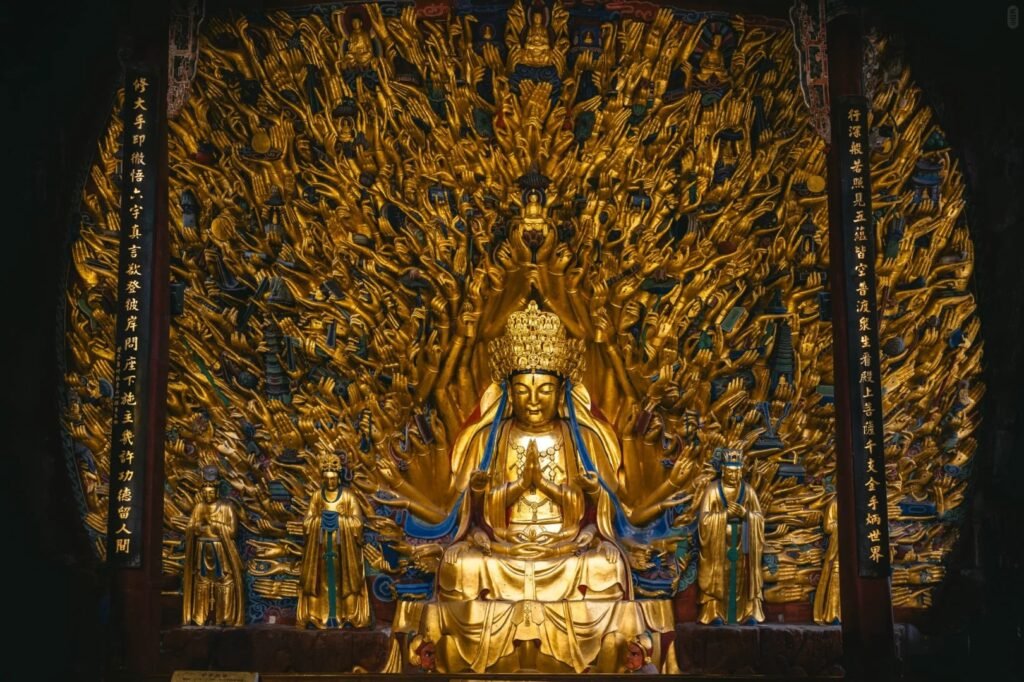
From a distance, the hands form a field of gold around a calm central figure. Move closer and the wall breaks into details. Palms carry eyes. Hands hold ritual implements, tools and objects drawn from ordinary life.
The image expresses a simple, generous idea: suffering takes many forms, so compassion needs many ways to respond.
The carving has survived more than eight centuries of humidity, water, weathering and earlier repairs. A major rescue-conservation project began with surveys and testing in 2008, entered full restoration in 2011 and was completed in 2015. Knowing this changes the way you look. The gold is not merely decoration; it is part of an ongoing decision to carry a fragile work into another century.
Do not spend the whole stop trying to count the hands. Watch how they change as you shift position. From the front, they radiate outward. From the side, individual wrists, fingers and objects begin to separate. The image moves because you do.
The Parents’ Kindness Scenes: A Sacred Wall About Family Life
One of Baodingshan’s most affecting groups does not begin with a distant heaven. It begins with parents.
The scenes show pregnancy, childbirth, feeding, care, worry, separation and the long work of raising a child. Their purpose is moral and religious, but their emotional language is domestic. A parent holds a baby. A mother bends forward. A family prepares for a child to leave home.
Visitors do not need a specialist vocabulary to understand why these images matter. The gestures are enough. Eight hundred years disappear for a moment because the anxiety of caring for someone has changed so little.
This is where Dazu’s meeting of traditions becomes easier to understand. Buddhist teaching is expressed through a concern deeply associated with Confucian family ethics: gratitude toward parents and responsibility within the family. The traditions are not presented as abstract labels. They meet inside a scene people recognise.

The Ox-Herding Pictures: Learning to Live With Your Own Mind
Along another stretch of cliff, a herdsman and an ox move through a sequence of changing moods.
At first, the animal is difficult to control. The herdsman pulls, follows and struggles. Gradually the ox becomes calmer. Eventually the tension between them disappears.
The images use the ox as a metaphor for the mind and the herdsman as the person learning to guide it. Yet the carving never loses its rural life. You still see the animal’s weight, the rope, the uneven ground and the body of someone accustomed to work.
The result is both philosophical and local. A difficult idea about discipline and inner calm becomes a story anyone who has tried to change a habit can understand.
The Reclining Buddha: A Body Larger Than the Frame
The long reclining figure represents the Buddha entering final nirvana. Only part of the body is shown; the rest seems to continue into the cliff.
That choice makes the rock itself part of the image. The body is too large to be contained by the visible scene, while the faces around it carry grief, attention and acceptance.
This is not a sculpture to photograph and immediately leave. Stand back first. Then look at the people around the central figure. Their reactions give the scene its emotional scale.
The Wheel of Rebirth: An Entire Moral World in One Image
The Wheel of Rebirth compresses different states of existence, choices and consequences into a single dense composition. Without explanation, the panel can look like an impressive circle crowded with figures. With a guide, it becomes a map of how actions, desire and suffering connect.
This is a good example of why interpretation matters at Dazu. The most important detail is not always the largest figure. A small gesture near the edge can explain the whole scene.

The Hell Tableaux: Fear Used as a Public Lesson
Not every scene at Baodingshan is gentle.
The hell tableaux show punishment, suffering and the consequences of harmful actions with deliberate force. They were not carved simply to frighten visitors. In a society where many people could not read a written religious text, an image made the warning immediate. Cruelty, greed and betrayal become visible outcomes rather than abstract ideas.
The scenes can feel severe to a modern visitor, yet they complete the moral world of the valley. Compassion has greater weight because suffering is shown beside it. The cliff offers both reassurance and warning.
The Perfect Enlightenment Cave: A Quieter Kind of Attention
After the large outdoor panels, the Perfect Enlightenment Cave changes the pace. The space is enclosed, the figures sit in a more ordered relationship, and the eye no longer has to take in an entire cliff at once.
This is a useful reminder that Dazu does not work only through spectacle. Some of its strongest moments come when the route becomes quiet enough to study a face, the fall of a robe or the distance between two figures.
Baodingshan or Beishan: Which Should You Visit?
For a first Dazu visit, choose Baodingshan.
Baodingshan has the clearest connected narrative, the largest scenes and the strongest introduction for someone without a background in Buddhist art. It rewards two to three unhurried hours.
Beishan is older, quieter and more intimate. Its cliff is filled with smaller niches created over a longer period, beginning in the late 9th century. The carving can be exceptionally delicate: calm faces, fine jewelry, folded cloth and complex arrangements contained within relatively small spaces.
Because Beishan developed across the late Tang, Five Dynasties and Song periods, walking along it also means watching artistic preferences change. Some niches carry the authority of military or official patronage; others reflect the prayers of local devotees. Instead of one continuous program, you encounter belief in individual rooms: a Water-Moon Guanyin with a relaxed posture, a densely carved sutra-repository cave, a protective deity chosen for a particular hope.
Add Beishan when:
- you already know you enjoy Buddhist sculpture;
- you want to compare late Tang and Song styles;
- you have enough daylight and energy after Baodingshan;
- it appears in your confirmed written itinerary.
Do not add it simply because “more sites” sounds like better value. Baodingshan deserves your freshest attention. Beishan should feel like a deeper second chapter, not a rushed final checkbox.
Do You Need a Guide at Dazu?
You can visit independently. The paths are clear, the famous carvings are visually impressive and background information is available through signs or audio options.
But Dazu is one of the places where a knowledgeable human guide changes the quality of the day.
Without context, the cliff can flatten into “another Buddha, another panel, another photograph.” With context, you begin to notice why a mother appears beside a religious scene, why an ox changes character across the wall, why some figures look frightened and others calm, and how the order of the carvings builds an argument.
A good guide also helps with questions that do not fit neatly on a sign:
- Why does this scene feel so different from Longmen or Dunhuang?
- Where do Buddhist, Taoist and Confucian ideas meet in the carvings?
- Which colors are historical, and which surfaces have been conserved?
- Why was this valley designed as a connected route?
- What should we look at before the crowd moves on?
Before booking any “guided” Dazu day trip, ask one simple question: who will actually enter the site with you and explain the carvings? A vehicle and a translation app can get you to Baodingshan. They cannot show you why the scenes were arranged in this order or which small gesture changes the meaning of an entire panel.
EzGoChina confirms a real English- or Spanish-speaking guide for your date before payment. A driver using a translation app is not presented as your cultural guide, and joining a shared scenic-area commentary group is not presented as a private guided tour.
The guide should not talk over the carvings. The right rhythm is to point out one visible detail, give you the story, answer the question that follows, and then leave enough silence for you to look.
Want the carvings explained without joining a large lecture group? Tell us your date and preferred language. We will confirm the real guide before you pay and build the day around Baodingshan rather than a rushed site list. Ask Which Dazu Route Fits Us
A Realistic Dazu Day Trip From Chongqing
In EzGoChina’s planning, a private Dazu day normally takes about 10 to 11 hours from a central Chongqing hotel. Driving time is often around 1.5 to 2.25 hours each way, depending on traffic, pickup location and the entrance used.
Morning: Leave Chongqing and Set the Context
Leaving the dense city for the western countryside is part of the day. The towers thin, the road opens and the scale of Chongqing municipality becomes easier to understand.
When useful and open, a short museum introduction can give you the historical frame before Baodingshan. It should support the carvings, not use up the attention you came to give them.
Late Morning to Early Afternoon: Protect Baodingshan
EzGoChina’s standard plan keeps roughly 2.5 hours for the main Baodingshan route. That gives enough time to follow the connected scenes, ask questions and stop when a detail catches your eye.
The Thousand-Armed Guanyin may be the image that first draws you in. The family scenes and ox-herding sequence are often what stay with you on the drive back.
Lunch: Keep It Local and Simple
Lunch is paid separately, so your group can choose according to appetite and dietary needs. Tell the guide about allergies, vegetarian requirements and spice preferences before departure.
Afternoon: Beishan Only When It Fits
Beishan is optional, not an automatic promise. It is added when requested, practical and written into the final route. If the museum is closed, a conservation area is restricted or the group needs a slower pace, the day protects Baodingshan rather than forcing extra stops.
Evening: Return to Central Chongqing
This is a full day. Do not plan a fixed evening show immediately after the expected return. Traffic and the natural pace of the carvings can move the schedule.
How EzGoChina Plans a Private Dazu Day
We confirm the service scope in writing before payment rather than hiding behind a vague “guided tour” label. A standard private arrangement is built around:
- central Chongqing hotel pickup and drop-off;
- a private air-conditioned vehicle with driver for the confirmed service time;
- a private English- or Spanish-speaking cultural guide, subject to date availability;
- a Baodingshan-first route, with Beishan added only when requested and confirmed;
- WhatsApp or WeChat coordination before departure;
- no shopping stops.
Unless your written quote says otherwise, attraction tickets, required or optional scenic transport, meals, drinks and gratuities are paid separately. The written quote explains which on-site costs remain separate and, where available, the current expected amount. Your guide, vehicle, route, pickup arrangement and cancellation terms are all confirmed before payment.
Walking, Weather and Conservation
Dazu involves moderate walking rather than hiking, but it is not a fully step-free visit. Expect outdoor paths, gradients, steps and periods of standing while the guide explains the carvings. Wear comfortable shoes with grip.
Light rain does not necessarily stop the visit. Heavy weather, maintenance or conservation work may close an individual niche or change the route. Some carvings may be partly covered to protect them. A responsible guide works with what is open rather than promising access that nobody can guarantee.
Bring the original passport used for any ticket reservation. Opening days, ticket policies and museum arrangements can change, so they should be checked for your exact date.
Who Will Love Dazu?
Dazu is especially rewarding for:
- travelers interested in Chinese history, belief and art;
- visitors who prefer stories and close observation to a physically demanding landscape day;
- couples, families with older children and small private groups who like asking questions;
- travelers looking for a quieter UNESCO day beyond central Chongqing;
- people who assume they “do not understand Buddhist art” but respond to human stories.
It may not suit travelers who need a fully wheelchair-accessible route, prefer a fast photo-stop day, or expect to see all five carving clusters in a single visit.
Is Dazu Better Than Wulong?
They are not competing versions of the same day.
Choose Dazu for stone, silence, history and stories that reward close attention. Choose Wulong for giant natural bridges, gorges, long walks and a stronger physical encounter with the landscape.
If your knees, weather forecast or interests point toward a calmer day, Dazu is often the better decision. If you want the day to feel like an outdoor adventure, choose Wulong.
The Detail You Take Home
The Thousand-Armed Guanyin may be the photograph you show first.
But memory is less obedient than a camera. On the road back to Chongqing, you may find yourself thinking about a parent holding a child, a rope between a man and an ox, or one small face your guide asked you to notice.
That is the quiet achievement of Dazu. It takes large ideas—compassion, duty, desire, consequence and grief—and gives them hands, bodies and ordinary expressions.
The cliff does not ask you to arrive as an expert. It asks you to look a little closer.
Want to see Dazu without spending hours researching transport, ticket rules and translations? Send EzGoChina your travel date, group size, preferred guide language and central Chongqing hotel. We will confirm the real guide and vehicle, shape the day around your interests and send the full quote before you pay. Plan My Dazu Day