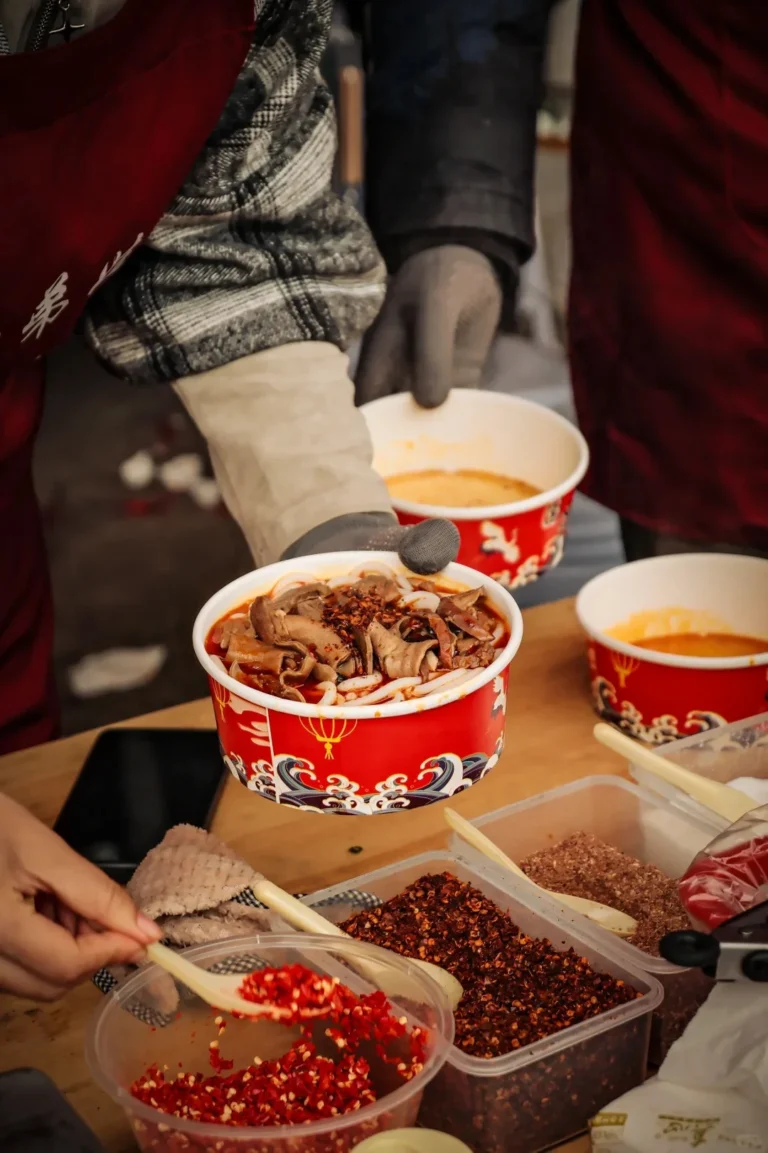
Chongqing Food Guide: 15 Dishes You Can’t Leave Without Trying
Most tourists eat at the wrong places in Chongqing. They follow Google Maps to restaurants with English menus and walk away thinking they’ve tried real Chongqing food.
They haven’t.
I’ve spent three years taking travelers to the places locals actually eat. The shops with no signs, no English, and lines out the door at 7am. This is what you should be eating.
1. Chongqing Hotpot (重庆火锅)
What it is
A bubbling cauldron of beef tallow, dried chilies, and Sichuan peppercorns. You cook raw ingredients yourself in the broth. The tallow is what makes it different from hotpot anywhere else – it creates a thick, aromatic base that coats everything you cook.
What my clients always ask: “Why does this taste so different from hotpot in other cities?”
The answer: Real Chongqing hotpot uses beef tallow (牛油), not vegetable oil. That’s the difference between “spicy” and “I can’t stop eating this.”
How to eat it
Order a half-spicy pot (鸳鸯锅) if you’re new. Cook beef tripe for exactly 15 seconds – any longer and it turns to rubber. Duck blood goes in for 2-3 minutes. Lotus root and potato absorb the broth best. Save the noodles for last to soak up what’s left.
Dish Details & Tips
- What to order: Duck blood (鸭血) – sounds scary, tastes like silky tofu. Beef tripe (毛肚) – cook for exactly 15 seconds, no more. Lotus root (藕片) – absorbs the broth perfectly. Potato noodles (宽粉) – order at the end to soak up leftover broth.
- Price: 60-200 yuan per person depending on what you order.
- Spice level: Extreme. Request 鸳鸯锅 (half-spicy pot) if needed.
- Possible allergens: Sesame oil in dipping sauce. Some broths contain peanut oil.
- Tourist trap warning: Avoid hotpot restaurants in Hongyadong or Jiefangbei with picture menus. If they have an English sign outside, locals don’t eat there.
Where to go
- Zhu’s Hotpot (朱氏胖子烂火锅): Jiefangbei area. The only place in the tourist zone where locals eat. Go before 6pm or wait 2 hours. No English menu but staff will point at pictures.
- Dezhuang Hotpot (德庄火锅): Multiple locations. Consistent quality, good for first-timers. Has picture menu. 80-150 yuan per person.
- Qiaotou Hotpot (桥头火锅): Nanping area. Old-school setup, plastic stools. Locals only, zero tourists. 60-100 yuan per person.
- Liu Yishou (刘一手): Chain but locals approve. Late night option (open until 2am). Good for groups.
- Xiaolongkan (小龙坎): Guanyinqiao location is best. Modern setup, clean bathrooms. Slightly more expensive but worth it for comfort.
2. Chongqing Noodles (重庆小面)
What it is
Thin wheat noodles in a sauce made from chili oil, Sichuan peppercorn oil, soy sauce, and vinegar. Every shop has a different ratio – that’s the secret. Topped with pea shoots, peanuts, and pickled mustard greens.
This is what 8 million Chongqing residents eat for breakfast. Not congee, not dumplings – spicy noodles at 7am.
How to eat it
Order at the counter, pay first, grab a seat. It arrives in 3 minutes. Mix everything together before eating. Slurp the noodles – it’s normal here. Finish in 10 minutes while it’s hot.
Dish Details & Tips
- What to order: Just say “重庆小面” (Chongqing xiaomian). Add-ons: 加蛋 (jiā dàn) – add egg +2 yuan, 加肉 (jiā ròu) – add pork +5 yuan, 多放豌豆尖 (duō fàng wāndòu jiān) – extra pea shoots.
- Price: 8-20 yuan. Cheapest breakfast in the city.
- Spice level: Very spicy. You can ask for less chili oil (少放辣椒) but locals will look at you funny.
- Possible allergens: Peanuts (topping), sesame oil (in sauce).
- What my clients say: “Why are we eating this at 7am?” Then they order a second bowl.
Where to go
I’ve tested 30+ noodle shops with clients. The best ones have a line of locals at 7am, plastic stools, and zero English. If you see tourists, keep walking.
- Huajia Yiyuan Noodles (花甲怡园小面): Shapingba district. Open 6:30am-11am only. Line starts at 6:45am. 12 yuan per bowl.
- Banbianjie Noodles (半边街小面): Yuzhong district. Locals’ favorite for 20 years. Tiny shop, 8 seats. 10 yuan per bowl.
- Dongzi Noodles (东子小面): Near Guanyinqiao. Thicker noodles, more chili oil. 15 yuan per bowl.
- Laotaipo Noodles (老太婆摊摊面): Jiangbei district. Street-side setup. Best pea shoots in the city. 8 yuan per bowl.
- Shunfeng 123 (顺风123): Multiple locations. Cleaner setup for tourists. Still authentic. 18 yuan per bowl.
3. Chuan Chuan (串串香)
What it is
Hotpot on sticks. Pick skewered ingredients from a fridge, cook them in communal spicy broth, pay by counting empty skewers at the end. It’s cheaper than hotpot and more social.
Why locals love it: Same flavor as hotpot, half the price, and you can try 40 different things instead of committing to a full hotpot order.
How to eat it
Grab a basket, load it with skewers, dump them in the pot. Cook meat 3-5 minutes, vegetables 2-3 minutes. Stack empty skewers on your plate – that’s how they count. Average person eats 30-40 skewers.
Dish Details & Tips
- What to order: Beef (牛肉) – 2 yuan per stick. Quail eggs (鹌鹑蛋) – 0.50 yuan per stick. Potato (土豆) – 0.50 yuan per stick. Lotus root (藕片) – 0.50 yuan per stick. Mushrooms (蘑菇) – 1 yuan per stick.
- Price: 0.50-3 yuan per skewer. Full meal is 40-60 yuan.
- Spice level: Very spicy. The broth gets spicier as the night goes on.
- Possible allergens: Sesame oil (dipping sauce), peanuts (some locations).
- Pro tip from 200+ tours: Go early (6-7pm) if you’re spice-sensitive. By 9pm, the broth has been cooking for hours and will destroy you.
Where to go
- Yulin Chuanchuan (玉林串串香): Nanping area. Most famous in Chongqing. Always packed after 7pm. 50-80 yuan per person.
- Kaorou Chuanchuan (烤肉串串香): Guanyinqiao. Mix of grilled and boiled skewers. Unique style. 60-100 yuan per person.
- Malatang Chuanchuan (麻辣烫串串): Jiefangbei back streets. Cheaper option. 30-50 yuan per person.
- Liangfen Chuanchuan (凉粉串串): Shapingba university area. Student prices. 25-40 yuan per person.
4. Mao Xue Wang (毛血旺)
What it is
A stew of duck blood, beef tripe, ham, eel, and bean sprouts in spicy broth, topped with a mountain of dried chilies. The duck blood soaks up all the flavor.
Origin story: Invented by dock workers in the 1940s who needed cheap, filling food. They couldn’t afford good meat, so they cooked offal in spicy broth to mask the taste. Now it’s on every menu in the city.
How to eat it
Push aside the chilies to find the ingredients. Don’t eat the dried chilies unless you want to suffer. The duck blood is the best part – it has a silky texture like soft tofu. Order rice to soak up the broth.
Dish Details & Tips
- What to order: Most places only have one version. Just say “毛血旺” (mao xue wang). It comes with everything already in it.
- Price: 35-60 yuan. Serves 2-3 people.
- Spice level: Extreme. No mild option exists.
- Possible allergens: Soy sauce, sesame oil. Sometimes contains peanuts.
- Real talk from my tours: I’ve never had a client finish a full bowl alone. Order one for 2-3 people or you’ll be sweating through your shirt halfway through.
Where to go
- Mao Xue Wang Originator (毛血旺发源地): Ciqikou ancient town. Claims to be the original. Tourist area but actually good. 50 yuan per pot.
- Lao Sichuan Restaurant (老四川酒楼): Nanping. Locals’ version. Bigger portions. 40 yuan per pot.
- Shancheng Mutton Restaurant (山城羊肉馆): Jiangbei. Their mao xue wang has extra tripe. 45 yuan per pot.
5. Spicy Chicken (辣子鸡)
What it is
Deep-fried chicken pieces buried under dried chilies and Sichuan peppercorns. The ratio is about 70% chilies, 30% chicken. The chicken is fried until crispy, then tossed with the chilies.
The game: Dig through the mountain of chilies to find the chicken pieces. It looks insane but tastes incredible.
How to eat it
Use chopsticks to dig through the chilies. The chicken pieces are small – eat them whole. Don’t eat the dried chilies. The numbing sensation comes from the peppercorns stuck to the chicken.
Dish Details & Tips
- What to order: Just order 辣子鸡 (la zi ji). Sizes: 小份 (xiǎo fèn) – small 40 yuan, 中份 (zhōng fèn) – medium 60 yuan, 大份 (dà fèn) – large 80 yuan.
- Price: 40-80 yuan per plate.
- Spice level: Very spicy, but the chicken itself is mild. The heat comes from the chilies coating it.
- Possible allergens: Peanut oil (frying), sesame seeds (garnish).
- What my clients say: “This looks insane.” Then they try it and order a second plate. Every single time.
Where to go
- Geleshan Spicy Chicken (歌乐山辣子鸡): Geleshan area (the original). Worth the trip outside the city. 60 yuan per plate.
- Lao Sichuan Spicy Chicken (老四川辣子鸡): Multiple locations. Consistent quality. 50 yuan per plate.
- Qiqi Spicy Chicken (七七辣子鸡): Guanyinqiao. Extra crispy version. 55 yuan per plate.
6. Suan La Fen (酸辣粉)
What it is
Hot and sour sweet potato noodles. The noodles are translucent and have a bouncy, chewy texture. The broth is spicy and sour from vinegar. Topped with peanuts, pickled vegetables, and chili oil.
Why it’s different: The noodles are made from sweet potato starch, not wheat. They’re slippery and have a texture you can’t find anywhere else.
How to eat it
Mix everything together first. The vinegar cuts through the spice. Eat it as a snack between meals, not as a main dish – it’s too light.
Dish Details & Tips
- What to order: Just say “酸辣粉” (suan la fen). Add-ons: 加肉 (jiā ròu) – add minced pork +3 yuan, 加蛋 (jiā dàn) – add egg +2 yuan.
- Price: 8-15 yuan per bowl.
- Spice level: Medium spicy. The sourness balances it out.
- Possible allergens: Peanuts (topping), soy sauce.
- Street food reality: Best eaten standing at a street stall. If it’s in a sit-down restaurant, it’s probably not as good.
Where to go
- Haochi Street Suan La Fen (好吃街酸辣粉): Jiefangbei area. Multiple vendors, try a few. 10 yuan per bowl.
- Jiefangbei Suan La Fen (解放碑酸辣粉): Near Jiefangbei monument. Thicker noodles. 12 yuan per bowl.
- Guanyinqiao Night Market (观音桥夜市): Multiple stalls. Open after 6pm. 8-10 yuan per bowl.
7. Grilled Fish (烤鱼)
What it is
A whole fish (usually grass carp or catfish) grilled over charcoal, then placed in a metal tray with vegetables, chilies, and broth. It keeps cooking at your table. The fish is crispy on the outside, tender inside.
This is Chongqing’s answer to hotpot when you want something different. Same spice level, different format.
How to eat it
The fish comes deboned (mostly). Pick off pieces with chopsticks. The vegetables underneath soak up the sauce – eat those too. Order rice or noodles to add to the leftover sauce.
Dish Details & Tips
- Pick your fish: Grass carp (草鱼) – most common. Catfish (鲶鱼) – richer, fattier. Black carp (乌鱼) – firmer texture.
- Pick your flavor: Spicy (麻辣) – classic Chongqing style. Sour and spicy (酸辣) – unique to some restaurants. Pickled pepper (泡椒) – less numbing, more sour.
- Price: 80-150 yuan per fish. Serves 2-4 people.
- Spice level: Medium to very spicy depending on what you order.
- Possible allergens: Fish (obviously), soy sauce, sesame oil.
- What happens on tours: People order one fish thinking it’s enough. Then they see the size and order noodles to stretch it. Plan accordingly.
Where to go
- Tansuan Grilled Fish (探酸烤鱼): Multiple locations. Sour and spicy version (unique). 100-120 yuan per fish.
- Wanzhou Grilled Fish (万州烤鱼): Nanping area. Original Chongqing style. 80-100 yuan per fish.
- Banbianjie Grilled Fish (半边街烤鱼): Yuzhong district. Smaller fish, cheaper. 60-80 yuan per fish.
8. Grilled Skewers (烧烤)
What it is
Charcoal-grilled meats and vegetables brushed with chili oil, cumin, and Sichuan peppercorns. This is late-night food – locals eat it after 9pm with beer.
Why it matters: This is where Chongqing people go after dinner. Not a meal, a social event.
How to eat it
Order a variety. Lamb skewers are the best. Grilled eggplant is surprisingly good. Chicken wings take 15 minutes. Squid is chewy. If you’re brave, try grilled pork brain (烤脑花) – it tastes like creamy tofu.
Dish Details & Tips
- What to order: Lamb skewers (羊肉串) – 5-8 yuan each, order 10. Chicken wings (鸡翅) – 3-5 yuan each. Grilled eggplant (烤茄子) – 8-12 yuan. Squid (鱿鱼) – 10-15 yuan. Pork brain (烤脑花) – 15-20 yuan.
- Price: 2-8 yuan per skewer. Full meal is 50-100 yuan.
- Spice level: Medium spicy. You can ask for less spice (少放辣椒).
- Possible allergens: Sesame (garnish), peanut oil (some vendors).
- Late night reality: The best BBQ happens after 10pm. If you show up at 7pm, you’re eating alone. This is when locals come out after their actual dinner.
Where to go
- Jiaochangkou Night Market (较场口夜市): Multiple vendors. Open 8pm-2am. Try different stalls.
- Nanbin Road BBQ Street (南滨路烧烤街): Riverside location. More expensive but better atmosphere. 80-150 yuan per person.
- Guanyinqiao Pedestrian Street (观音桥步行街): Student area, cheaper. 40-80 yuan per person.
- Daping BBQ Alley (大坪烧烤巷): Locals only. Plastic stools, street-side. 30-60 yuan per person.
9. Bing Fen (冰粉)
What it is
A cold jelly dessert with brown sugar syrup. The jelly is made from a plant seed and has a slippery texture. Topped with peanuts, raisins, hawthorn, and sometimes fruit. This is your 救命稻草 after eating spicy food.
What it does: Instantly cools your burning mouth. The jelly is neutral, the brown sugar is sweet, and together they save you from the spice.
How to eat it
Eat it slowly. Let it cool your mouth down. The brown sugar is sweet, the jelly is neutral. Some places add ice – that’s the best version.
Dish Details & Tips
- What to order: Just say “冰粉” (bing fen). Add-ons: 加水果 (jiā shuǐguǒ) – add fresh fruit +3 yuan, 加芋圆 (jiā yù yuán) – add taro balls +2 yuan.
- Price: 5-10 yuan per bowl.
- Spice level: Not spicy. It’s a dessert.
- Possible allergens: Peanuts (topping), some versions have sesame.
- What I tell every client: Order this after hotpot. Not optional. Your mouth will thank you. I always end food tours with this – clients call it “magic.”
Where to go
- Haochi Street Bing Fen (好吃街冰粉): Jiefangbei area. Classic version. 8 yuan per bowl.
- Ciqikou Bing Fen Stalls (磁器口冰粉摊): Multiple vendors in ancient town. Try a few, they’re all different. 5-8 yuan per bowl.
- Guanyinqiao Bing Fen (观音桥冰粉): Near the mall. Bigger portions. 10 yuan per bowl.
10. You Tiao + Soy Milk (油条 + 豆浆)
What it is
Deep-fried dough sticks dipped in warm soy milk. The most common Chinese breakfast. The you tiao is crispy outside, soft inside. The soy milk is unsweetened (you can ask for sugar).
This is your break from spicy food. Not spicy, not numbing, just simple and filling.
How to eat it
Tear the you tiao into pieces, dunk in soy milk, eat while hot. Some people add sugar to the soy milk.
Dish Details & Tips
- What to order: 油条 (yóutiáo) – fried dough stick 2-3 yuan. 豆浆 (dòujiāng) – soy milk 3-5 yuan. 加糖 (jiā táng) – add sugar if you want it sweet.
- Price: 5-10 yuan for both.
- Spice level: Not spicy.
- Possible allergens: Soy (obviously).
- Morning reality: This is what locals eat before the spicy noodles. Or instead of, if they’re not feeling the heat that day. Every breakfast shop has this.
Where to go
- Any small breakfast shop (早餐店): They’re everywhere. Look for places with locals. All taste similar.
- Yonghe Soy Milk (永和豆浆): Chain, cleaner setup. Good for tourists. 12 yuan for the combo.
11. Baozi (包子)
What it is
Fluffy steamed buns with meat or vegetable fillings. The dough is soft and slightly sweet. Common fillings: pork and cabbage, beef, red bean paste (sweet).
Another non-spicy breakfast option. Locals grab these on the way to work.
How to eat it
Eat them fresh from the steamer when they’re too hot to hold. Bite a small hole first to let steam escape. 3-4 buns is one meal.
Dish Details & Tips
- What to order: 猪肉白菜包 (zhūròu báicài bāo) – pork and cabbage 2-3 yuan. 牛肉包 (niúròu bāo) – beef 3-4 yuan. 豆沙包 (dòushā bāo) – red bean paste 2 yuan.
- Price: 2-5 yuan per bun.
- Spice level: Not spicy.
- Possible allergens: Depends on filling. Pork buns have soy sauce.
- Steamer timing: Best between 7-9am when they’re making fresh batches every 20 minutes. After 10am, you’re eating yesterday’s reheated buns.
Where to go
- Laozhang Baozi (老张包子): Shapingba area. Thin skin, lots of filling. 3 yuan per bun.
- Goubuli Baozi (狗不理包子): Tourist trap but actually decent. More expensive. 5 yuan per bun.
- Street vendors near subway exits: Cheapest option. 2 yuan per bun. Quality varies.
12. Liang Gao (凉糕)
What it is
Cold sweet rice cake with brown sugar syrup. It has a firm jello-like texture. Served cold, sometimes with ice. Another cooling dessert for after spicy food.
How to eat it
Cut it into pieces with a spoon. The brown sugar is very sweet. Eat it slowly.
Dish Details & Tips
- What to order: Just say “凉糕” (liáng gāo). It only comes one way.
- Price: 5-8 yuan per bowl.
- Spice level: Not spicy. It’s sweet.
- Possible allergens: None usually. Some versions have sesame.
- Bing fen vs liang gao: Bing fen is slippery and soft. Liang gao is firmer and chewier. Both cool you down. Order whichever sounds better.
Where to go
- Ciqikou vendors (磁器口小摊): Multiple stalls. 5 yuan per bowl.
- Haochi Street (好吃街): Near the bing fen stalls. 6 yuan per bowl.
13. Chongqing Wonton (抄手)
What it is
Wontons in spicy chili oil sauce. The wontons are thin-skinned with pork filling.
Why it’s different: Cantonese wontons swim in clear soup. Chongqing wontons drown in chili oil. Completely different dish. The sauce is the star here, not the filling.
How to eat it
Mix the wontons with the sauce before eating. Don’t drink the sauce like soup – it’s too spicy. The wontons are slippery, use a spoon.
Dish Details & Tips
- What to order: Just say “抄手” (chāo shǒu). Versions: 红油抄手 (hóng yóu chāo shǒu) – red oil wontons (spicy). 清汤抄手 (qīng tāng chāo shǒu) – clear soup wontons (not spicy).
- Price: 12-25 yuan per bowl.
- Spice level: Very spicy (red oil version).
- Possible allergens: Peanuts (some versions), sesame oil, soy sauce.
- What happens: People order the red oil version thinking they can handle it. Then they spend 20 minutes eating 10 wontons. Pace yourself.
Where to go
- Laoma Wonton (老妈抄手): Multiple locations. Most famous chain. 18 yuan per bowl.
- Longchaoshou (龙抄手): Sichuan chain, also in Chongqing. Slightly less spicy. 20 yuan per bowl.
- Street vendors near universities: Cheaper, spicier. 10-12 yuan per bowl.
14. Gan Guo (干锅)
What it is
“Dry pot” – stir-fried ingredients with chilies, served sizzling over a flame at your table. Common versions: chicken, frog, cauliflower (vegetarian).
What makes it special: It keeps cooking while you eat. The first bite is different from the last bite – everything gets crispier and more flavorful.
How to eat it
It arrives bubbling. Wait 2 minutes for it to cool slightly. The ingredients at the bottom get the most flavor. You can add noodles or rice to the pot later to soak up the sauce.
Dish Details & Tips
- What to order: 干锅鸡 (gān guō jī) – chicken 50-60 yuan. 干锅田鸡 (gān guō tiánjī) – frog 60-80 yuan. 干锅花菜 (gān guō huācài) – cauliflower 30-40 yuan.
- Price: 40-80 yuan per pot. Serves 2-3 people.
- Spice level: Very spicy.
- Possible allergens: Soy sauce, sesame oil, peanut oil (cooking).
- Table dynamics: The pot stays hot the whole meal. Don’t touch the metal tray. People always forget and burn their fingers.
Where to go
- Xiaolong Gan Guo (小龙干锅): Guanyinqiao area. Frog version is best. 60 yuan per pot.
- Bashi Gan Guo (巴适干锅): Multiple locations. Cauliflower version for vegetarians. 40-50 yuan per pot.
- Shancheng Gan Guo (山城干锅): Nanping area. Chicken version. 50 yuan per pot.
15. Liang Mian (凉面)
What it is
Cold noodles in sesame paste, chili oil, and vinegar. Perfect for summer when it’s 40 degrees outside. The noodles are chewy, the sauce is nutty and spicy.
Summer survival food. When it’s too hot to eat anything else, locals eat this.
How to eat it
Mix everything together before eating. The sesame paste is thick – make sure it coats all the noodles. Eat it cold.
Dish Details & Tips
- What to order: Just say “凉面” (liáng miàn). Add-ons: 加黄瓜 (jiā huángguā) – add cucumber +1 yuan, 加鸡丝 (jiā jī sī) – add shredded chicken +3 yuan.
- Price: 8-15 yuan per bowl.
- Spice level: Medium spicy.
- Possible allergens: Sesame (main ingredient), peanuts (some versions), soy sauce.
- Seasonal reality: You’ll only find this May-September. In winter, nobody makes it. If you’re visiting in cold months, skip this one.
Where to go
- Haochi Street vendors (好吃街): Multiple stalls. 10 yuan per bowl.
- University area food courts: Cheaper. 8 yuan per bowl.
- Jiefangbei back streets: Look for places with locals. 12 yuan per bowl.
How to Actually Use This Guide
Most tourists read a guide like this and then wander around hoping to stumble into good food. That’s not how it works in Chongqing. The best places don’t have English signs. They don’t show up on Google Maps. The staff doesn’t speak English. You can’t just walk in and point at a menu.
That’s where we come in. On our food tours, you eat at 5-6 of these places in one night. We handle the ordering, explain what you’re eating, and make sure you don’t accidentally order pig intestines when you wanted noodles. You get to try everything without the language barrier, without the guesswork, and without eating at tourist traps.
Book a tourOr keep wandering. Your choice.
What You Need to Know Before You Go
- Spice levels are real: When we say “very spicy,” we mean it. Start with 微辣 (slightly spicy) even if you think you can handle heat. Chongqing spice is different – it’s not just hot, it numbs your mouth.
- Most places don’t take cards: Set up Alipay or WeChat Pay before you arrive. Some places still take cash but it’s getting rare.
- You don’t tip: Seriously. Don’t leave money on the table. It confuses people.
- Meal times matter: Noodle shops close by 11am. Night markets don’t open until 8pm. If you show up at the wrong time, you’ll find nothing.
- The best places look sketchy: Plastic stools, no AC, staff yelling at each other – that’s where locals eat. If it looks too clean and has an English menu, keep walking.
Chongqing food is not for everyone. It’s spicy, it’s intense, and you’ll sweat through your shirt.
But if you want to eat what locals actually eat, this is it.
See you in Chongqing.